


Book Your Consultation Today!
Our company takes pride in its capacity to meet its client’s needs and create flexible and scalable services and solutions that exceed current and future company requirements.

Transforming a Complex Pharmaceutical Reference into an Intelligent Digital Knowledge Platform
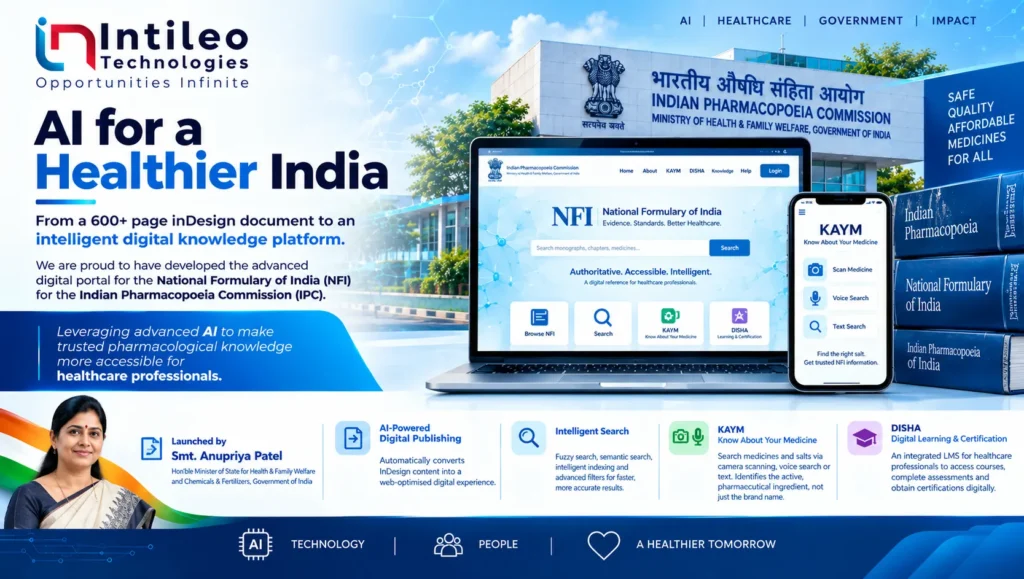
Healthcare professionals depend on authoritative and reliable information when prescribing, dispensing and administering medicines.
The National Formulary of India (NFI) serves precisely this purpose. The Indian Pharmacopoeia Commission describes the NFI as an authoritative guide for healthcare professionals and notes its role in promoting the rational and appropriate use of medicines. (Indian Pharmacopoeia Commission)
But a modern healthcare professional increasingly expects information to be:
This created an interesting technology challenge:
How do you transform a professionally authored pharmaceutical reference publication into an intelligent digital knowledge ecosystem without losing the integrity and structure of the original content?
That was the challenge behind the development of the new NFI digital platform for the Indian Pharmacopoeia Commission (IPC).
Developed by Intileo Technologies, the platform combines automated digital publishing, AI-powered search, natural language processing, computer vision, voice interfaces and digital learning capabilities into a single ecosystem.
The platform was launched by Smt. Anupriya Patel, Hon’ble Minister of State for Health & Family Welfare and Chemicals & Fertilizers, Government of India.
The launch coincided with the release of the 7th Edition of the National Formulary of India (NFI 2026). According to reporting on the launch, NFI 2026 contains 34 chapters, 20 appendices and 653 drugs, including 42 fixed-dose combinations and 30 immunologicals. (DD India)
At first glance, digitising a publication may appear straightforward.
Upload a PDF → Create some web pages → Add a search box
But pharmaceutical reference material presents a very different challenge.
The information is highly structured and interconnected.
A single publication can contain:
chapters,
drug information,
monographs,
tables,
references,
structured headings,
cross-references,
pharmaceutical terminology,
abbreviations,
formulations,
dosage information,
and other clinically relevant information.
Simply converting pages into HTML does not create a useful digital knowledge platform.
The real requirement was to preserve the meaning and structure of the content, while making it digitally searchable and accessible.
IPC has also been actively pursuing digitalisation initiatives around the NFI. Its 2026 updates include a GeM process specifically relating to the digitalisation of the National Formulary of India. (Indian Pharmacopoeia Commission)
This required a technology architecture capable of bridging the gap between:
Authoring → Content Processing → Knowledge Extraction → Search → Discovery → Learning
Book a free consultation for your business
Intileo Technologies developed a digital platform that brings together multiple technologies rather than treating the NFI as simply an online book.
The platform consists of several interconnected capabilities:
Together, these components transform the NFI from a static publication into an interactive digital knowledge ecosystem.
One of the most important components of the platform is its ability to process the InDesign source version of the NFI.
Traditionally, converting a large professionally designed publication into a web platform can involve significant manual work.
Content needs to be:
The platform automates a significant portion of this workflow.
InDesign → Content Extraction → Structure Recognition → Content Processing → Digital Formatting → Indexing → Web Publication
This means the source publication can become the foundation for a structured digital experience rather than requiring the entire publication to be manually recreated for the web.
The technology is particularly relevant for organisations managing:
A conventional website search generally depends on exact keyword matching.
That approach becomes restrictive when users are searching complex medical and pharmaceutical information.
For example, users may:
The NFI platform therefore incorporates multiple search mechanisms.
Fuzzy search helps identify relevant results even when the search query does not exactly match the indexed text.
This is particularly useful for:
Semantic search goes beyond matching individual words.
It attempts to identify the meaning and contextual relevance of a query.
This creates a more natural discovery experience for users who may not know the exact terminology used within the NFI.
Search can also be refined using structured filters, allowing users to narrow down information more efficiently.
The resulting architecture can be represented as:
User Query → Query Understanding → Fuzzy Matching + Semantic Retrieval → Relevance Processing → Structured Results
This combination is particularly important for large healthcare knowledge repositories where users need to find authoritative information quickly.
One of the key innovations within the platform is KAYM — Know About Your Medicine.
The objective is simple:
Make it easier for healthcare professionals to identify a medicine and reach the relevant pharmaceutical information.
Instead of requiring users to manually type a medicine name, KAYM provides multiple interaction methods.
A healthcare professional can use the device camera to capture information from medicine packaging.
The computer vision pipeline can process the captured information and help identify the relevant medicine/salt information.
Users can also interact with KAYM using voice.
This provides an alternative to typing, particularly when users are working in environments where hands-free interaction can be useful.
Traditional text search remains available as another interaction layer.
The result is a multimodal medicine discovery system:
Camera + Voice + Text → AI Processing → Medicine/Salt Identification → Relevant NFI Information
One of the important design principles behind KAYM is the distinction between a commercial brand name and the active pharmaceutical ingredient/salt.
Different pharmaceutical brands can contain the same active ingredient.
Therefore, a system designed around pharmaceutical knowledge needs to move beyond simply recognising a brand.
The KAYM workflow is designed to help identify the relevant active pharmaceutical ingredient/salt and connect the user to the corresponding NFI information.
This creates a fundamentally different experience from a conventional medicine search application.
Medicine packaging is rarely presented to a computer vision system under perfect conditions.
Real-world usage can involve:
This makes medicine recognition considerably more challenging than a simple OCR exercise.
The KAYM architecture therefore combines image processing, OCR and intelligent information extraction to convert visual information into searchable pharmaceutical entities.
Image Capture
↓
Image Pre-processing
↓
OCR / Text Extraction
↓
Entity & Pharmaceutical Information Extraction
↓
Salt / Ingredient Identification
↓
NFI Knowledge Retrieval
This is an example of where AI becomes useful not as a standalone chatbot, but as part of a larger workflow.
The NFI platform extends beyond information discovery.
It also includes DISHA, a Learning Management System designed for healthcare professionals.
DISHA provides an integrated digital learning environment where professionals can:
This introduces another important dimension to the platform.
Instead of creating separate systems for:
Knowledge → Learning → Assessment → Certification
the ecosystem brings these experiences together.
The broader vision of the platform can therefore be represented as:
DISCOVER
Find authoritative pharmaceutical information.
↓
IDENTIFY
Use KAYM to identify medicines and relevant salts.
↓
UNDERSTAND
Access NFI information and supporting knowledge.
↓
LEARN
Access professional learning through DISHA.
↓
ASSESS
Complete online assessments.
↓
CERTIFY
This creates a much more comprehensive digital experience for healthcare professionals.
Book a free consultation for your business
The project required multiple AI technologies working together rather than a single AI model.
AI & Machine Intelligence
Computer Vision
Voice Technology
Digital Content Engineering
Learning Technology
The important architectural principle was that AI was embedded into the workflow rather than added as a standalone feature.
Healthcare technology requires a different approach from consumer applications.
The platform deals with authoritative pharmaceutical information, which means that the system should not treat generative AI as an unrestricted source of truth.
The architecture therefore focuses on connecting users to structured and authoritative NFI content.
This is an important distinction.
Rather than asking a generic AI model:
“What is this medicine?”
the system can use AI capabilities to identify the relevant pharmaceutical entity and then connect the user to the appropriate information within the authoritative knowledge base.
This approach helps separate:
AI-assisted discovery
from
authoritative pharmaceutical information.
That distinction is particularly important for healthcare applications.
One of the most important lessons from the project is that digitisation and digital transformation are not the same thing.
Digitisation asks:
“How do we convert this document into a digital format?”
Digital transformation asks:
“How can technology fundamentally change how people interact with this knowledge?”
The NFI project moves towards the second model.
The original document remains the source of authoritative information.
But technology adds new layers:
Structured Content
→
Searchability
→
Semantic Understanding
→
Multimodal Interaction
→
Knowledge Discovery
→
Learning
→
Certification
That is what turns a digital publication into a digital knowledge ecosystem.
At a high level, the solution can be viewed as multiple interconnected layers.
Layer 1 — Content Ingestion
Receives the original publication and associated digital assets.
Layer 2 — Content Intelligence
Extracts and structures the content using document processing, OCR and AI techniques.
Layer 3 — Knowledge Layer
Creates structured relationships between content, pharmaceutical entities, chapters, medicines and searchable concepts.
Layer 4 — Search & Discovery
Provides:
Layer 5 — Multimodal AI
Provides:
Layer 6 — User Applications
Provides:
This layered architecture allows the platform to evolve as new AI capabilities become available.
The significance of this project goes beyond the technology itself.
The NFI exists to support healthcare professionals and promote rational use of medicines. IPC describes it as a resource for medical professionals, pharmacists, nurses, students and other healthcare stakeholders. (Indian Pharmacopoeia Commission)
The digital platform creates new ways for these users to access and interact with that knowledge.
It brings together:
Authoritative Knowledge + AI + Search + Computer Vision + Voice + Digital Learning
within a single ecosystem.
The broader context is also significant: IPC’s current digital initiatives include work around pharmacovigilance, medicine safety and AI-powered approaches to pharmacopoeia standards and pharmacovigilance practices. (Indian Pharmacopoeia Commission)
At Intileo Technologies, we believe that successful AI projects are not about simply adding a chatbot or an LLM to an existing application.
The real opportunity lies in identifying where intelligence can fundamentally change a workflow.
For the NFI platform, that meant asking:
How can a publication be automatically transformed into a digital knowledge platform?
What if healthcare professionals could search without knowing the exact terminology?
How could a camera become an interface to pharmaceutical knowledge?
Could voice make information discovery more accessible?
What would it take to turn the same platform into a learning and certification ecosystem?
These questions shaped the product architecture.
| Capability | Technology / Approach |
| Automated digital publishing | Structured content processing |
| Intelligent search | Fuzzy + semantic search |
| Content discovery | AI-powered retrieval |
| Medicine identification | Computer vision + OCR |
| KAYM | Camera + voice + text |
| Pharmaceutical entity identification | AI/NLP-based processing |
| Digital learning | Integrated LMS |
| Online assessment | Digital assessment engine |
| Certification | Online certification workflow |
| Knowledge platform | Structured NFI content |
The NFI digital platform demonstrates how an established knowledge resource can evolve into a modern technology ecosystem.
The future of healthcare information platforms is unlikely to be just:
“Search a document.”
It is moving towards:
“Ask → Identify → Understand → Learn → Act.”
AI, computer vision, voice interfaces and semantic search provide the technological foundation for that evolution.
And when these technologies are combined with authoritative domain knowledge, they can create digital platforms that are considerably more useful than simply reproducing a printed publication online.
The architecture created for this project provides a foundation for further innovation across healthcare and pharmaceutical technology.
Potential future capabilities include:
The objective remains the same:
Use technology to make trusted healthcare knowledge more accessible, discoverable and useful.
The NFI project represents an important milestone for Intileo Technologies in building AI-powered solutions for complex, regulated and knowledge-intensive environments.
From automated document transformation to semantic search, from computer vision to voice interfaces, and from medicine discovery to professional certification, the platform demonstrates how multiple technologies can come together to solve a real-world healthcare challenge.
The future isn’t simply about digitising information.
It’s about making information intelligent, accessible and actionable.
Intileo Technologies builds AI-powered digital platforms and enterprise technology solutions for organisations undergoing digital transformation.
Our capabilities span:
We work with organisations to transform complex, manual and knowledge-intensive processes into intelligent digital workflows.
Interested in building an AI-powered platform for your organisation?
Also read:
Book a free consultation for your business
The NFI digital platform demonstrates how advanced technology can transform complex, knowledge-intensive information into an intelligent and accessible digital experience. By combining AI-powered search, computer vision, voice interaction, automated digital publishing, and digital learning, Intileo Technologies has helped create a connected healthcare knowledge ecosystem rather than simply digitising a traditional publication.
For Intileo Technologies, this project represents how AI, healthcare technology, and digital transformation can work together to solve real-world challenges in regulated and information-intensive environments. The platform creates a foundation for continued innovation while making trusted healthcare knowledge more discoverable, accessible, and useful for healthcare professionals
The National Formulary of India (NFI) is an authoritative reference intended to guide healthcare professionals in the prescribing, dispensing and administration of medicines and to promote rational use of medicines. (Indian Pharmacopoeia Commission)
The NFI digital portal is a digital knowledge platform developed for the Indian Pharmacopoeia Commission that provides digital access to NFI content along with intelligent search, medicine discovery, KAYM and professional learning capabilities.
KAYM stands for Know About Your Medicine. It provides a multimodal interface through which healthcare professionals can search for medicine and salt information using camera scanning, voice and text.
The platform combines fuzzy search, semantic search, structured indexing and filtering to help users find relevant information even when their query does not exactly match the terminology contained in the NFI.
DISHA is the digital learning and certification component of the platform. It provides healthcare professionals with access to courses, assessments and online certification.
The platform combines technologies including natural language processing, semantic search, fuzzy matching, OCR, computer vision, voice processing, intelligent information retrieval and automated content processing.
We build digital solutions & products that drive & enhance business models.
Welcome to Intileo Technologies, where we listen to you and develop solutions for your business. We partner with you and ensure the solution is developed for your business within TAT and Budget.
We are a team of enthusiastic developers always working on current, new, and futuristic technologies. Hence giving you the best solution on the latest technologies.
Copyright (c) 2026 intileo technologies. All rights reserved.